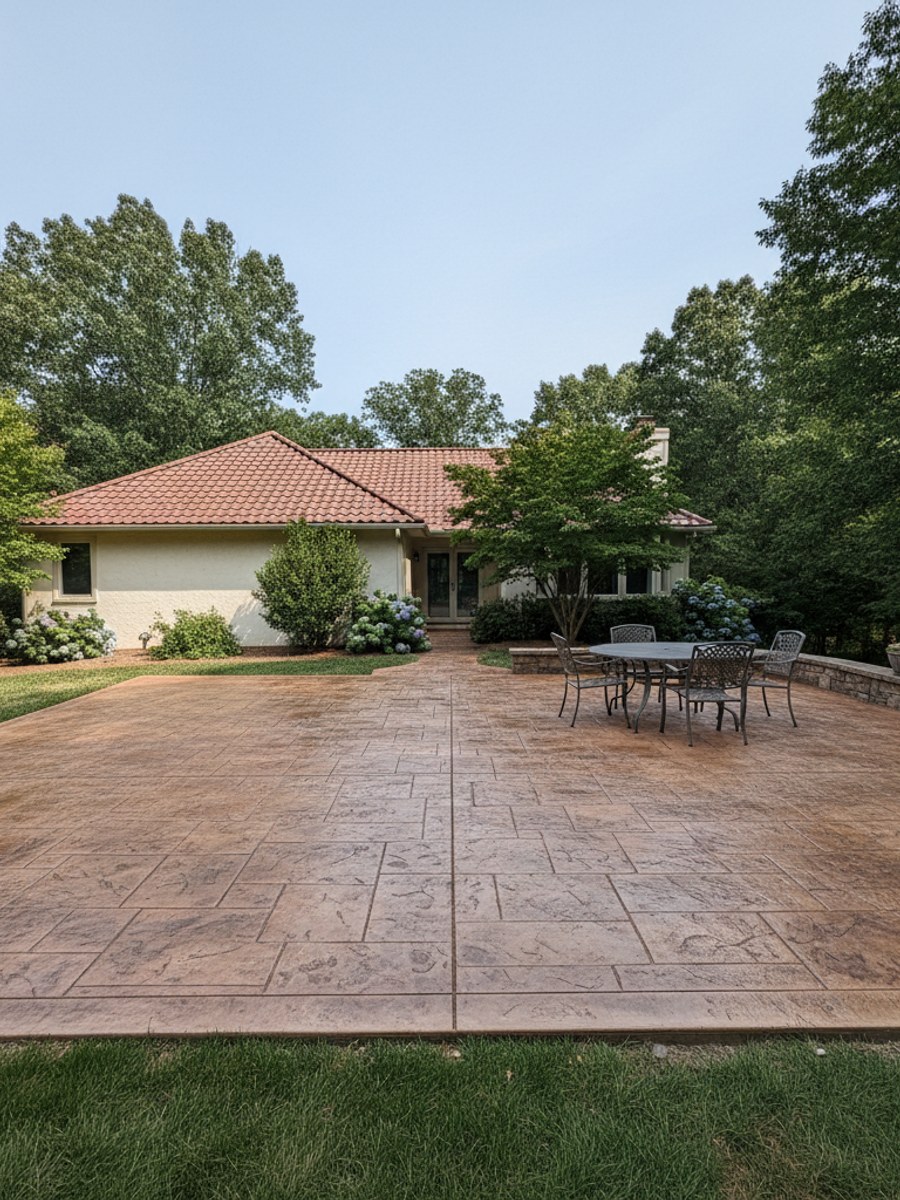
Concrete looks like a simple product. Gray, hard, flat. But what separates a driveway that lasts 25 years from one that's cracked and heaving by year five happens before the truck ever shows up, and most homeowners never ask about it. Here's what to actually check when you're picking someone to pour concrete at your house in the Richmond area.
Ask what's going under the slab, not just what's on top
Richmond sits near the fall line, where the Piedmont's rocky soil meets the Coastal Plain's sandier ground, and a lot of neighborhoods in between have heavy clay subsoil. Clay swells when it's wet and shrinks when it dries out, and that movement is what cracks slabs that were poured directly onto ungraded dirt. A contractor who knows the ground here will excavate, compact the subgrade, and lay down 4 to 6 inches of crushed stone before any concrete goes down. If someone quotes you a driveway or patio without mentioning gravel base or compaction, ask directly. If they shrug it off, that's your answer.
This matters more in older parts of the city, Church Hill, the Fan, parts of Manchester, where houses went up in the early 1900s and the soil around the foundation has been disturbed, filled, and re-disturbed for a century. It matters differently in newer Chesterfield and Henrico subdivisions, where the lot was graded by a developer and the base is usually more consistent, but the clay underneath hasn't gone anywhere.
The mix and the steel matter more than how smooth it looks the day it's poured
Ask what PSI concrete they're using. A driveway or garage floor should be running 3,500 to 4,000 PSI, not the 2,500 mix that's fine for a low-traffic walkway. Ask whether it's air-entrained. Richmond doesn't get brutal winters, but we get enough freeze-thaw swings between December and February, that cold snap followed by a 50-degree afternoon, that a slab without air entrainment will start scaling and flaking at the surface within a few winters.
Then there's reinforcement. Rebar on a grid, usually 18 to 24 inches, holds a slab together better than wire mesh, and it's not close. Mesh only does anything if it's pulled up into the middle of the pour, and on a lot of quick jobs it just gets walked into the bottom of the slab and sits there doing nothing. If a contractor tells you mesh is standard and doesn't mention pulling it up during the pour, that's a corner being cut quietly.
Thickness isn't negotiable, even if it seems like a small detail
A standard driveway slab should be 4 inches thick, 5 to 6 inches if it's going to see a lot of vehicle weight or a boat trailer. A sidewalk can run thinner. Someone who's vague on the thickness they're planning to pour, or who won't put it in writing, hasn't thought it through, or is planning to save on material.
Permits and drainage aren't optional extras
New slab foundations, structural work, and often driveway aprons that tie into the public right-of-way need a permit, whether that's through the City of Richmond's planning and development review office or through Henrico or Chesterfield County's building department, depending on where you live. A licensed contractor deals with this routinely and should be able to tell you, before they start, whether your job needs a permit, whether a survey or setback check applies, and whether your inspector needs to look at the subgrade and steel before the pour or just the finished slab. If you're in a neighborhood with an HOA, which is common in a lot of the newer subdivisions out toward Midlothian and Short Pump, check whether stamped concrete colors or driveway width are restricted before you fall in love with a design.
Drainage is the other piece nobody asks about until water is sitting on their new patio. Richmond gets heavy downpours in summer, plus whatever's left of hurricane season moving through from August into October, and a patio or walkway that doesn't pitch away from the house at roughly a quarter inch per foot will pond water against your foundation. A contractor should be talking to you about slope and where the water goes before they're talking about finish and color.
What happens after the pour, and why the timeline matters
Concrete doesn't cure the moment it's poured, and it doesn't cure the moment it looks solid, either. Control joints, the straight lines cut into a slab, need to go in within 24 to 48 hours, cut about a quarter of the slab's depth, spaced roughly two to three times the thickness in feet apart. Those joints tell the slab where it's allowed to crack as it shrinks, instead of letting it pick its own spot, usually right down the middle. You can typically walk on a new slab after a day or two. Don't drive on it for at least 7 days. Full strength takes closer to 28 days, which matters if you're planning to park a heavy trailer or an RV on it right away.
Summer heat here, especially July and August, speeds up the surface cure and can cause cracking if the crew isn't wetting it down or using a curing compound. A contractor who pours in the middle of a 95-degree afternoon without a plan for that isn't paying attention.
Red flags worth walking away from
- No written estimate that lists thickness, PSI, reinforcement type, and base depth. A price with no specs behind it is a guess.
- Can't produce proof of insurance on request. This one's non-negotiable.
- Wants full payment up front, before any material is delivered.
- Talks you out of a permit to save time, especially on a structural pour or anything touching the right-of-way.
- No mention of joints, curing time, or how they'll handle drainage. Silence on these usually means they haven't planned for them.
A rock-bottom bid is usually rock-bottom for a reason, whether that's thinner concrete, no gravel base, or a crew that's in and out in half a day without proper compaction. Concrete is one of those jobs where the mistakes are buried, literally, under four inches of slab, and by the time they show up as cracks or heaving, the contractor who cut the corner is long gone.
If you're weighing a driveway, a patio, a slab foundation, or a repair, ask the questions above before you ask about price. We go over subgrade, mix, and drainage on every estimate at Champion Concrete Solutions, and we're glad to walk through it with you whether or not you end up hiring us.